

Data-Constrained Battery Health Prognosis via Few-Shot and Generative Learning
Theory: Fewshot Learning, Early prediction, Generative Learning
Application: Battery Prognostics and health management; Energy storage system control
Funding Source: NSFC
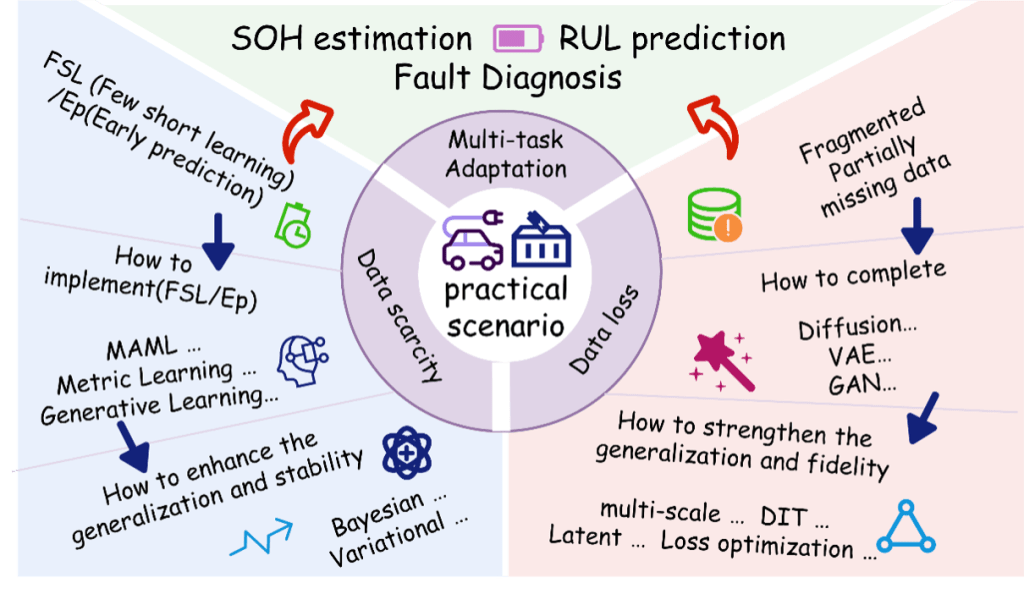
Background and Motivation
Research Topic: My research addresses data limitation challenges in battery health management: insufficient training samples, fragmented charging observations, and cross-domain distribution gaps. I focus on developing data-efficient machine learning solutions, integrating few-shot learning for rapid knowledge transfer, applying generative models for data completion and augmentation, and advancing early prediction techniques for real-time decision-making, thereby enabling reliable battery health prognosis in data-constrained practical scenarios.
Research significance: The research will develop targeted strategies for battery health management under practical data constraints. Few-shot learning approaches, including meta-learning and cross-domain transfer methods, will be explored to handle limited training samples. Generative techniques will be designed to reconstruct or generate complete patterns from fragmented data. Early prediction methods will be advanced to support timely assessment using partial cycle data. These complementary strategies aim to enable reliable battery prognostics in data-scarce industrial settings while reducing testing costs and time requirements.
Research importance: The potential importance spans multiple domains. For electric vehicles, accurate health management with minimal testing enables faster battery certification and improves safety through early fault detection. For energy storage systems, assessing battery health from limited data reduces operational costs and extends system lifespan through proactive maintenance. More broadly, these data-efficient methods lower barriers to battery technology deployment, particularly for newly deployed products where historical data is scarce, thereby accelerating the transition to sustainable energy systems.
Objective and aims
1. Develop few-shot learning frameworks for cross-domain battery health
2. Design generative models for complete battery cycle reconstruction from fragmentary data
3. Establish early prediction methods for timely battery health assessment.
Scientific Problems
1. Data scarcity and overfitting of battery health models In practical battery testing, only a limited number of batteries can be fully cycled and labelled, leading to sparse and imbalanced SOH/RUL datasets. Under this condition, conventional deep-learning models tend to overfit specific cells and operating profiles, resulting in poor robustness and limited generalization to unseen batteries and duty cycles.
2. Learning from incomplete and fragmentary operational data Real-world operational logs often contain only partial charging segments, missing sensor channels, and irregular sampling. Such incomplete and fragmented data bring serious challenges to battery PHM algorithms: key health indicators become unreliable, model outputs fluctuate, and degradation or fault trends may be detected too late or even misjudged. Therefore, a key scientific problem is how to effectively reconstruct or complete critical degradation information under severely missing and fragmentary observations, and how to leverage generative models (such as diffusion models and variational autoencoders) together with uncertainty modeling to design PHM algorithms that are robust to missing-data patterns and can still provide stable and trustworthy SOH/RUL estimates under real-world operating conditions.
3. Reliable early-stage prediction and calibrated uncertainty under limited degradation history In many applications, we must predict long-term degradation and remaining life in the early stage using only a short history of cycles. However, the strongly nonlinear and regime-changing characteristics of battery ageing makes early predictions highly uncertain and unstable in traditional models, which typically provide point estimates without reliable uncertainty quantification. A key scientific problem is how to build data-efficient, uncertainty-aware predictors that remain reliable at early stages and can produce well-calibrated confidence intervals or probabilistic estimates—e.g., via Bayesian inference or related probabilistic correction mechanisms—so that predicted trajectories and RUL values do not systematically drift away from the true degradation process.
My Publications
[1] Ziheng Li, Chengxin Liu, Zeyu Chen, et al. Study on Characterization and Impact Factors of Lithium-ion Battery Thermal Runaway Induced by Nail-penetration. Journal of Electrical Engineering, 2025, 20(3): 225–232. (in Chinese)
[2] Chengxin Liu, Ziheng Li, Zeyu Chen, et al. Characterization study on overheat-induced thermal runaway for lithium-ion battery in energy storage. Energy Storage Science and Technology, 2024, 13(7): 2425–2431. (in Chinese)
[3]Zhou, N., Chen, Z., Zhang, B., Zhao, H., Li, Z., Liu, C., & Han, D. (2025). Comparative analysis of cylindrical lithium-ion battery responses to continuous and intermittent compression: Insights into safety and failure mechanisms. Energy, 136576.
 Digital Intelligent Battery Lab