

Closed-Loop Intelligent Management for Battery with Explainable Representation
Theory: Machine learning, Lifecycle management, Explainable AI
Application: Battery Management System (BMS), Battery Recycling
Funding Source: NSFC, Nation R&D Project
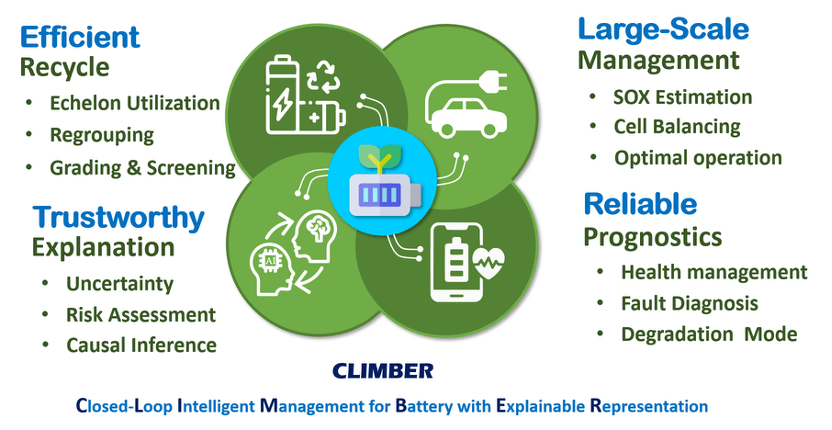
Background and Motivation
Research Topic: Construct a solution on how to evaluate, exploit, and improve the lifecycle value of battery assets via explainable artificial intelligence (XAI). Helping Battery Assets Climb the Value Chain.
Research significance: Establish a life cycle analysis (LCA) framework that decomposes the battery value lifecycle into four phases where the intelligent battery management system (IBMS) can be strategically deployed to optimize the overall profitability of battery assets. The impact of the explanation on battery assets is revealed quantitatively for the first time by employing a probabilistic lifetime value (LTV) model.
Research importance: This study provides a framework to guide decision-making on research focus within the closed-loop battery management system, thereby clarifying the research’s specific contribution. It translates the value of a specific technical improvement into a quantifiable metric for CEOs. It helps them assess the effectiveness of the investment allocation along the battery asset value chain by analyzing the LTV model, e.g., parameter sensitiveness analysis of the LTV model. Finally, the paper emphasizes the critical importance of trustworthy explanations from Explainable AI (XAI), highlighting their ability to mitigate expected LTV losses caused by uncertainty.
Objective and aims
1. Large-scale management system: scalable state estimations
2. Reliable health prognostics: prognostics and health management, fault diagnosis
3. Trustworthy explanation: multi-task physics-informed neural network (PINN), uncertainty quantification
4. Efficient recycle: rapid capacity grading and sorting, fast discharge protocol.
Scientific Problems
1. Scalable state estimations: scalable estimation algorithms and fault diagnosis executed on large-scale batteries across various operation conditions with low complexity.
2. Reliable health prognostics: accurate SOH estimation and RUL prediction with reliable uncertainty quantification. Degradation mode analysis based on physical model or multi-task PINN.
3. Efficient Recycle: identify critical tasks within the battery recycling stage. The echelon utilization requires rapid capacity grading and sorting. The discharge protocol involves a trade-off efficiency and effectiveness while ensuring safety.
My Publications
[1] H. Chen, G. Dong, S. Xie, Y. Wang and Y. Lou, “A Scalable Recurrent Structure With Fast Transfer Learning for Lithium-Ion Battery State of Charge Estimation at Different Ambient Temperatures,” in IEEE Transactions on Intelligent Transportation Systems, vol. 26, no. 10, pp. 14792-14806, Oct. 2025
[2] H. Chen, G. Dong, Y. Wang, J. Yu, L. Wu and Y. Lou, “Data-Driven Battery Health Prognosis Using Scalable Deep Recurrent Structure and Partial Fast-Charging Profiles,” in IEEE Transactions on Vehicular Technology, vol. 74, no. 11, pp. 17034-17046, Nov. 2025
[3]H. Chen, G. Dong, J. Wei and C. Chen, “A Probabilistic Scheme for Lifetime Prognostics of Lithium-Ion Batteries Using Stochastic Modeling and Approximated Monte-Carlo Filter,” 2025 International Conference on Networking, Sensing and Control (ICNSC), Oulu, Finland, 2025, pp. 21-27
 Digital Intelligent Battery Lab